
Dougherty County Criminal Records
A Dougherty County criminal court record is the case-level file the court keeps once a criminal matter enters the court system. It may include the filed charge, indictment, accusation, warrant, motions, plea entries, hearing dates, trial settings, verdict, disposition, sentencing order, probation terms, and appeal activity. The record is broader than a charge list and more formal than a jail record. Sheriff Terron K. Hayes oversees Sheriff's Office custody and public-safety functions, while the court file tracks the prosecution. For charge-only detail after arrest, the related Dougherty County arrest records and court charges page is the narrower route.
The court level depends on the offense and filing path. Superior Court handles felony criminal cases in the Dougherty Judicial Circuit. State Court handles misdemeanors punishable by twelve months or less. Albany Municipal Court handles city misdemeanors, traffic, DUI, underage alcohol, marijuana under one ounce, firearms, and ordinance matters. Magistrate Court is important at the front end because it has jurisdiction to issue warrants for all criminal offenses and hold committal hearings.
The District Attorney source is central to felony and misdemeanor prosecution in the circuit.
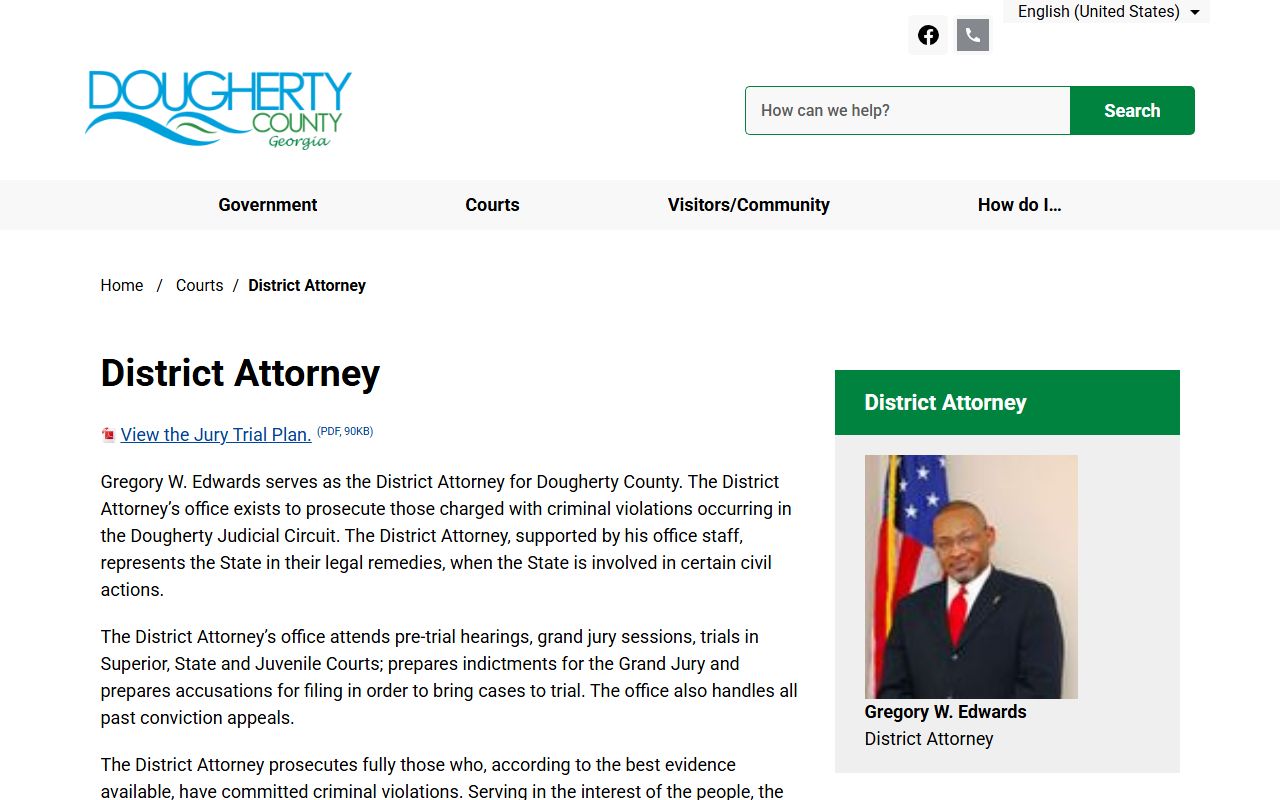
The District Attorney role helps explain why indictments, accusations, and trial activity appear in the court file after the arrest stage.
Search Dougherty Criminal Cases
The main online route is the Clerk of Courts Record System, which the county Clerk page labels as the civil and criminal case search. Public search routes include Search By Party, Search By Associated Party, and Search By Case Number. The portal tells users to enter last name followed by first name, avoid suffixes, use at least two letters, and search all spelling variations when results seem incomplete.
- Open the Clerk's civil and criminal case search and accept the portal disclaimer.
- Search by defendant name through the party route, or use the case-number route if the exact number is known.
- Review the returned case rows for court, case type, filing date, status, and defendant information.
- Open the case detail to read docket entries, hearings, pleadings, charges, disposition, and sentence when displayed.
- Contact the Clerk of Superior Court for certified copies, older files, sealed matters, or records not exposed online.
Clerk of Superior Court Phyllis N. Johnson's office is in the Judicial Building at 225 Pine Avenue, Suite 126, Albany, Georgia 31701. Phone is 229-431-2198, email is dococlerks@dougherty.ga.us, and business hours are 8:30 a.m. to 5:00 p.m. Monday through Friday. The mailing address is P.O. Box 1827, Albany, Georgia 31702.
Dougherty Criminal Case Flow
A criminal case record grows in stages. Arrest or warrant information may begin with law enforcement or Magistrate Court, but the court case file becomes the official prosecution record when charges, accusations, indictments, or citations are filed in the proper court. In Dougherty County felony matters, the path may run from arrest or booking to first appearance or committal functions, then to indictment or accusation practice in Superior Court through the District Attorney.
Case flow: Charges Filed › Arraignment › Pretrial / Motions › Plea or Trial › Disposition › Sentencing
| Stage | What Happens |
|---|---|
| Charges Filed | The accusation, indictment, citation, warrant, or other charging paper opens or defines the criminal case. |
| Arraignment | The court advises the defendant of charges and receives a plea such as guilty, not guilty, or nolo. |
| Pretrial / Motions | Parties file motions, request hearings, prepare evidence issues, and set or continue court dates. |
| Plea or Trial | The case resolves by plea, bench trial, jury trial, dismissal, or another court-approved outcome. |
| Disposition | The court records the final outcome of the charge or case. |
| Sentencing | If convicted, the record may show jail, probation, fines, treatment terms, or other sentence conditions. |
Dougherty Criminal Record Fields
A Dougherty County criminal court record should be read field by field. The defendant name and case number identify the matter. The court and case type show where it is pending. Charges show what was alleged. Docket entries show procedural movement. Plea, disposition, sentence, and probation terms show the outcome after adjudication. A single record can also include dismissed charges, amended counts, bond data, future hearings, and appeal activity.
| Field | What It Shows |
|---|---|
| Case Number | The unique court identifier for lookup, docket review, and certified copy requests. |
| Defendant | The person accused in the criminal court case. |
| Court | The venue handling the case, such as Superior Court, State Court, Magistrate Court, or Municipal Court. |
| Charge | The offense alleged in an indictment, accusation, citation, warrant, or other charging document. |
| Bond | Release security, bond type, status, or amount when included in the case or custody data. |
| Hearing | Arraignment, motion, trial, sentencing, review, or other scheduled court event. |
| Plea | The defendant's response, such as guilty, not guilty, or nolo. |
| Disposition | The final outcome, including conviction, dismissal, acquittal, nolle prosequi, or other closure. |
| Sentence | Punishment or terms imposed after conviction, such as incarceration, probation, fines, or treatment. |
| Appeal | Post-conviction or review activity when the record includes appellate or later court events. |
Dougherty Charges and Convictions
A charge is not a conviction. Dougherty County criminal court records may show charges that were filed and later dismissed, reduced, amended, or resolved without a guilty finding. The District Attorney prepares indictments for the grand jury and accusations for filing, but the court record must be checked for the final disposition before treating an allegation as a conviction.
| Point | Charge | Conviction |
|---|---|---|
| Meaning | An allegation filed by warrant, citation, accusation, indictment, or other charging paper. | A final guilty finding by plea, verdict, or court judgment. |
| Record Stage | Appears early in the case and may change. | Appears after adjudication and disposition. |
| Proof Level | Can be based on probable cause or formal charging review. | Requires a guilty plea, verdict, or other lawful conviction process. |
| Public Meaning | Should be read as pending or alleged unless disposition confirms outcome. | Can support sentencing, probation, DDS reporting for some traffic matters, or later criminal-history consequences. |
Note: Always read the disposition field before reporting a Dougherty County criminal charge as a conviction.
Dougherty Criminal Court Offices
The District Attorney and Public Defender explain much of the criminal court record. District Attorney Gregory W. Edwards prosecutes criminal violations occurring in the Dougherty Judicial Circuit. The office attends pretrial hearings, grand jury sessions, and trials in Superior, State, and Juvenile Courts; prepares indictments for the grand jury; prepares accusations for filing; and handles past-conviction appeals. The office is in the Judicial Building at 225 Pine Avenue, Suite 231, Albany, and the phone number is 229-431-3233.
The Public Defender's office handles indigent defense eligibility for people who cannot afford counsel in criminal cases. The office can receive the Application for Public Defender Services or email at publicdefender@dougherty.ga.us. The Public Defender's office is in the Judicial Building at 225 Pine Avenue, Suite 100, Albany, and the phone number is 229-483-6240. Troy Golden is listed as Dougherty Circuit Public Defender.
The Public Defender source is one of the official criminal court record context sources for Dougherty County.
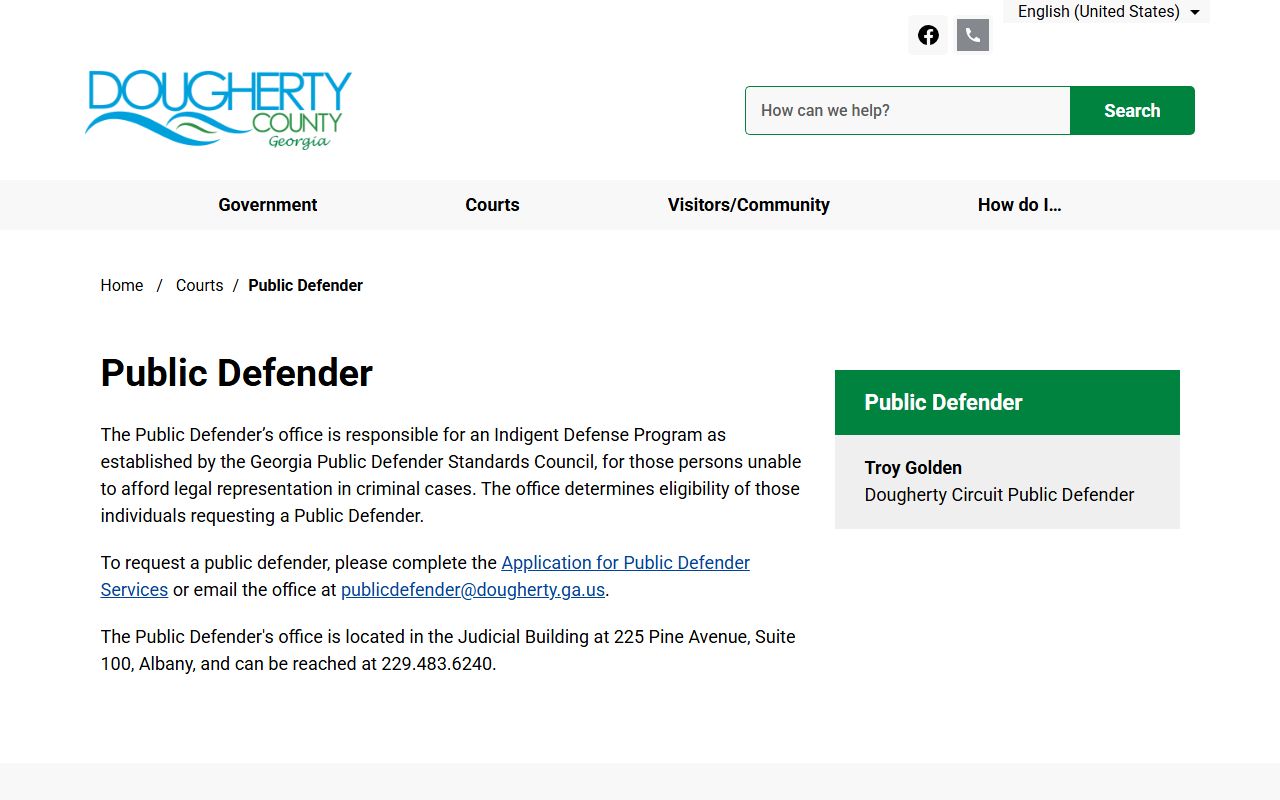
Defense eligibility and representation can affect motions, hearings, pleas, and other docket entries shown in a criminal case file.
Dougherty Sealed and Restricted Records
Georgia uses the term record restriction for many criminal-history access limits. The Georgia Bureau of Investigation record restriction page cites O.C.G.A. 35-3-37 and explains procedures for arrests before and after July 1, 2013. Restriction limits access for non-criminal-justice purposes when a record qualifies. That is different from a sealed court file, where a court order may restrict public inspection of case documents.
| Point | Sealed | Restricted |
|---|---|---|
| Primary Effect | Court inspection is limited by order or law. | Criminal history access is limited for non-criminal-justice purposes. |
| Typical Source | Court order, court rule, statute, or protected case type. | O.C.G.A. 35-3-37 and GBI or agency procedures. |
| Public Search Result | Case or document may be hidden or unavailable. | Arrest or history data may be restricted even if related court entries need separate review. |
| Who Confirms | The clerk or court that controls the case file. | GBI, prosecutor, arresting agency, or court path listed for the restriction type. |
The GBI record restriction source explains Georgia rules that affect how criminal history is shown outside the court file.
A restricted criminal-history record should be compared with the court docket before drawing conclusions about the case outcome.
Dougherty Juvenile Record Limits
Juvenile Court records are not ordinary public criminal court records. Dougherty County Juvenile Court handles delinquency, unruly or CHINS matters, children needing treatment or commitment, juvenile traffic, dependency, termination of parental rights, restitution, and juvenile traffic fines. The county source notes more than 2,200 petitions annually. Georgia juvenile access rules, including O.C.G.A. 15-11-700 through 15-11-710, treat many youth records separately from adult criminal files.
Juvenile matters can still intersect with criminal-record questions, especially when a person is trying to understand whether a court event is visible to the public. General web searches are a poor tool for those records. The court that holds the juvenile matter should be contacted for access rules, party access, and any court-order requirement.
The Juvenile Court source helps distinguish adult prosecutions from youth matters in Dougherty County.
That court-level distinction prevents juvenile records from being treated like adult Superior Court or State Court criminal dockets.
Dougherty Criminal Public Access
Criminal court records are generally public unless a law, court order, or protected case type limits inspection. The Georgia Open Records Act, summarized in the Attorney General open government guide, presumes public records are open under O.C.G.A. 50-18-70. O.C.G.A. 50-18-71 covers inspection and copying procedures. O.C.G.A. 50-18-72 lists exemptions, including records that may be withheld or redacted.
Public access does not mean every record is online or complete in the public portal. Active investigative records, sealed records, restricted criminal history, protected identifiers, and juvenile records may be unavailable. Certified criminal court copies come from the clerk or court office that holds the case record. Sheriff jail records and wanted-person records are different sources and should be used as custody or warrant checks, not final court outcomes.
Dougherty Criminal Case Outcomes
Some Dougherty County criminal cases may connect to treatment or accountability programs. Local specialty-court material includes substance-use and mental-health track context tied to court outcomes. A docket may show review hearings, sanctions, incentives, treatment attendance, or other case activity tied to a specialty court or diversion structure when the court records expose those events.
The local accountability court provider source gives context for treatment-focused criminal case outcomes in Dougherty County.

Those program details should be read as case-specific when they appear in the docket, not assumed for every criminal case.